
Digital design is changing at a speed that not many things have been as disruptive as immersive technologies. Of them, 3D modeling in virtual reality is transforming the way designers, architects, and developers design and experience virtual space. Although conventional 3D modeling methods have been in use, virtual reality (VR) brings with it new opportunities beyond the flat screens and inactive perspectives.
The knowledge of the distinctions between these two strategies can assist the businesses and creators to select the appropriate workflow to use in their projects. We can discuss what their comparison is and where each of them is superior.
Understanding Traditional 3D Modeling
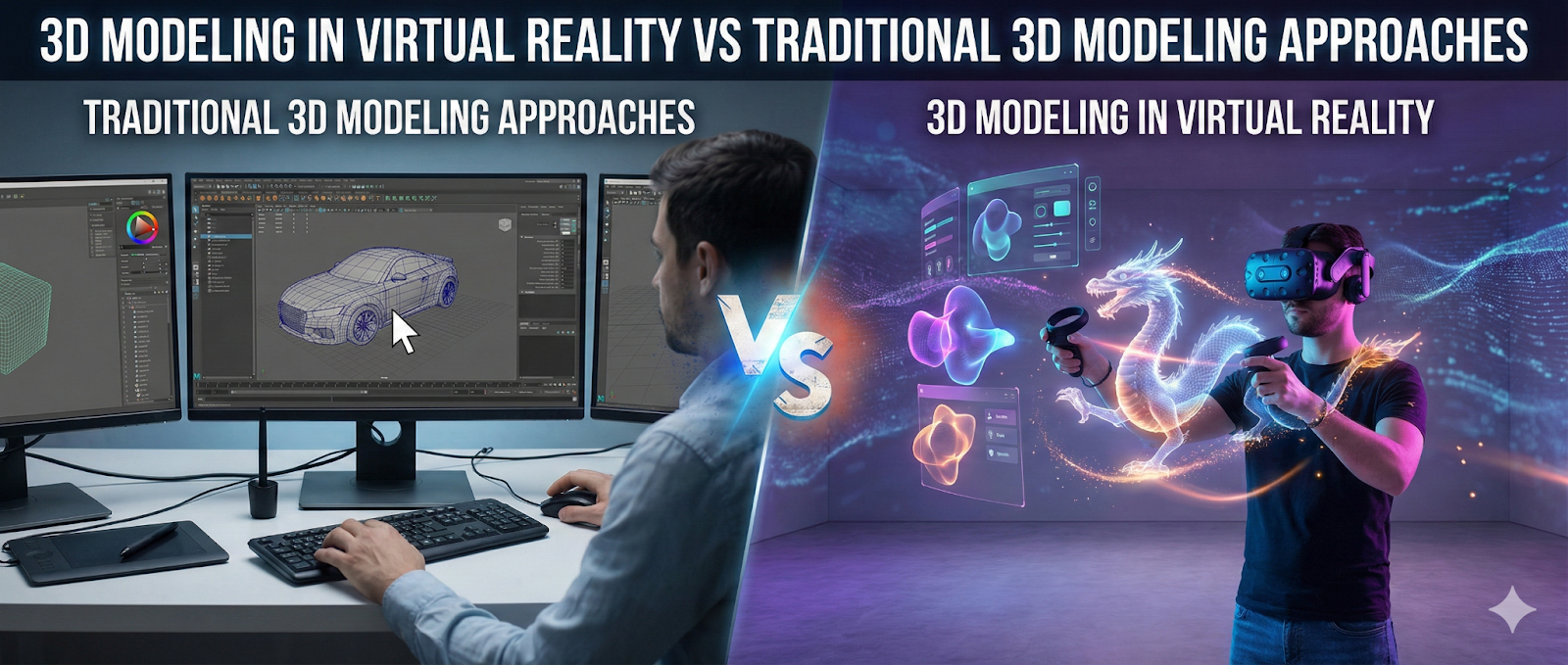
Conventional 3D modeling is normally carried out by the development of digital models using desktop-based software like CAD or 3D design software. Designers work with models by use of a mouse, keyboard, and a 2D monitor.
The industry standard has been this approach that is often applied by any 3D visualization company to:
- Architectural modeling
- Product design
- Engineering simulations
- Animation and rendering
Conventional 3D modeling provides accuracy, thorough control, and the ability to fit very many production pipelines.
What Is 3D Modeling in Virtual Reality?
Virtual reality is 3D modeling, which enables the designer to design and manipulate 3D objects in a complete immersion, three dimensional environment. With VR headsets, and motion controllers, users are able to perform sculptures, scaling and placement of models as if they were being in the real world.
Designers do not see a model on a screen, but enter the model that gives a real feeling of depth, proportion, and space. This practical engagement can be described as a major change in digital models creation and assessment.
Key Differences in Workflow
The most observable contrast between conventional modeling and VR-based modeling is in the workflow.
The older modeling is based on indirect communication, – users perceive the 3D space by the means of the 2D interface. This may limit spatial insight although it is useful in technical accuracy.
On the contrary, the virtual reality of 3D modeling involves a direct spatial interaction. The designers are able to move around objects, manipulate elements in real size, and alter them in real time from various perspectives. This tends to accelerate the ideation process, and the design decisions become more instinctive.
Precision vs Spatial Awareness
The classic 3D is very accurate. Precarious measurements, parameteric control, and geometry are simpler to control with traditional instruments. In engineering-intensive or very technical projects, this accuracy is essential.
However, virtual reality modeling puts more emphasis on space and scale. The designers can actually feel that a space is too narrow, too tall, or too enclosed. Most processes of generating 3D visualization companies nowadays combine the two methods- via VR to develop concepts, and by the time they are refined and detailed, they are done in traditional tools.
Collaboration and Client Engagement
Another sphere that VR-based modeling is exceptional in is cooperation. In conventional processes, the process of collaboration is frequently associated with the exchange of screenshots, renders, or files, which may be misinterpreted.
In virtual reality, there is 3D modelling, which allows other stakeholders to share the same model in an immersive setting. Clients have the ability to discover spaces, give immediate feedback, and get to know the intent of the design better. This will minimize revisions and enhance cross-team communication.
Learning Curve and Accessibility
The old school 3D modeling programs are steeply learned yet well documented and taught. These tools are already known to the majority of professionals.
VR modeling creates an additional learning process. Although this is easy to use and perform, it needs VR devices and initial training. Nevertheless, with closer access to technology, most teams in the 3D visualization companies are starting to incorporate VR modeling into their regular operations.
Cost and Infrastructure Considerations
In cost terms, the traditional method of 3D modeling needs the licenses of software and the usual computing devices. VR modeling is associated with the expense of headsets, controllers, and compatible systems.
With this said, virtual reality 3D modeling can help save money in other spheres through minimizing mistakes in design, quickening approvals, and enhancing decisions made at the initial stage. In the case of big or high-budget projects, the pay-off could be substantial.
Use Cases and Applications
The classic 3D modeling is still perfect in:
- Comprehensive construction specifications.
- Technical simulations and modeling.
- Final production-ready assets.
VR-based modeling is specifically effective in:
- Ideation and concept design.
- Planning of interior and architectural space.
- Design reviews and client walkthroughs.
- Training and demonstrations by experience.
Most of the contemporary processes involve a combination of the two to produce optimal outcomes.
The Future of 3D Modeling
Instead of substituting the ways of doing things, 3D modeling in virtual reality is broadening what can be done in digital design. The boundary of creation and experience will keep getting blurred as VR tools are becoming more powerful and integrated.
The innovative teams of forward-thinking 3D visualization companies are implementing hybrid workflows that combine the strengths of the two methods and provide superior designs, more understandable communication, and more interactive experiences.
Conclusion
Traditional 3D modeling and 3D modeling in virtual reality both possess their strong sides. Conventional approaches are more precise and reliable, whereas VR leads to immersion, spatial awareness, and improved collaboration.
The selection of the appropriate methodology relies on the purpose of the project, the complexity of the project and the audience. The combination of both approaches results in the most effective results in a number of situations. With the changing technology, virtual reality will take a more dominant role in the process of creation, experience, and communication of 3D models.
